3
About
Tips on choosing the best targets and building AI rollups that turn data and automation into real operational and financial gains.


Why Most Roll-Ups Fail
Most AI rollups fail because they believe the magic is “AI + buying companies.”
In reality, the long-term winners look nothing like financial rollups. They operate more like ai operating systems, data platform builders, automation of accounting process and change-management machines.
A successful AI rollup does not scale through acquisition velocity.
It scales through repeatable integration, data interoperability and AI workflow optimization.
Only when these foundations exist can AI meaningfully compound value across deals.
Traditional rollups extract value from scale and cost synergies.
AI rollups extract value from learning.
Every firm you buy becomes a new sensor, a new dataset, a new workflow sample - feeding a shared operating system that gets smarter with each integration.
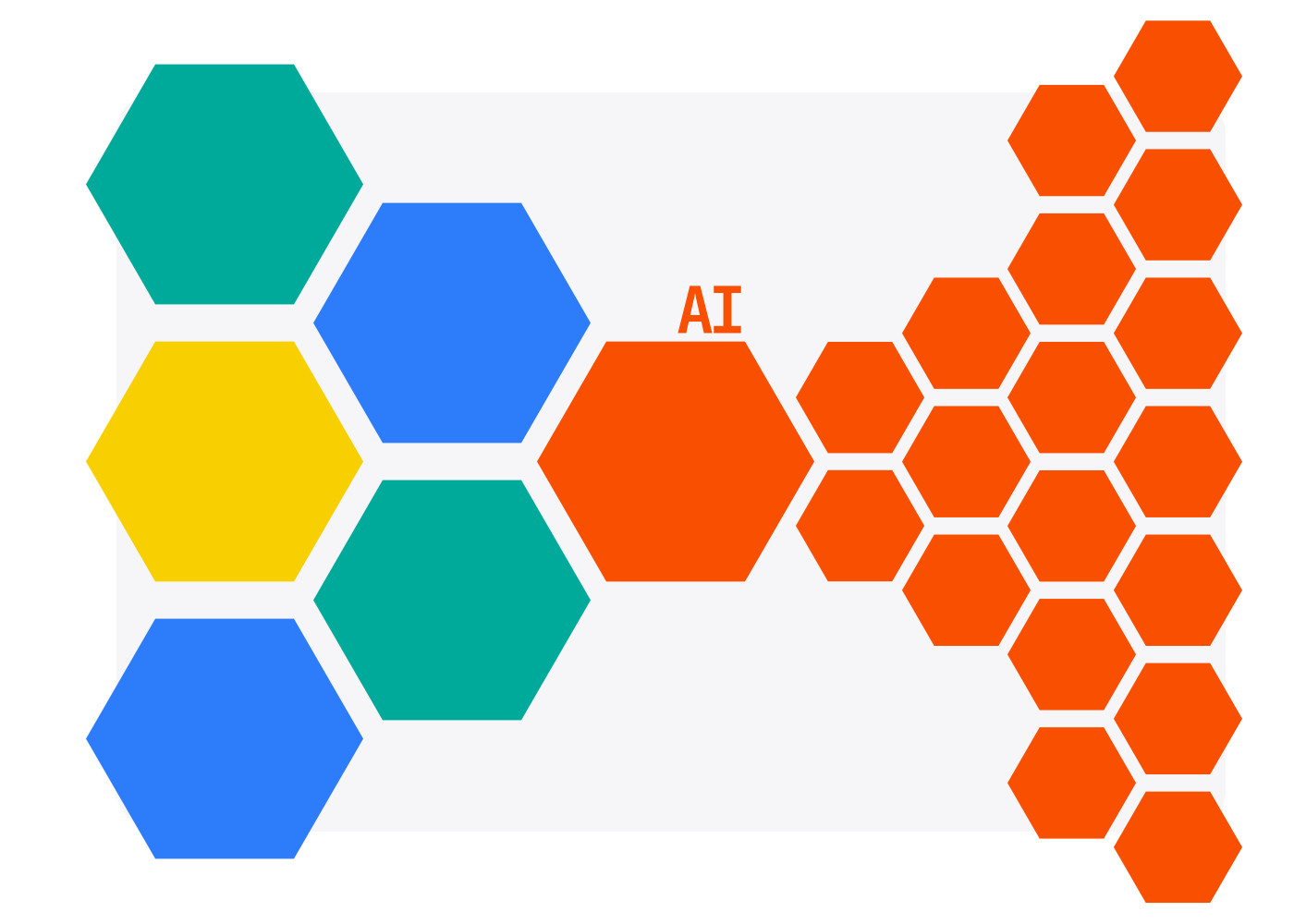
The AI enabled rollups become not a collection of companies, but a single organism that learns.
Best Roll-Up Targets: 5 Key Traits
Industries do not become rollup-ready because they are “fragmented” - thousands of markets are fragmented.
They become rollup-ready when fragmentation meets workflow repetition + digitizable data + trained labor shortages.
The best targets share 5 traits:
1. Fragmented, subscale operators - with predictable, repeated, not bespoke, work
Accounting workflow management, tax prep, property management, insurance servicing, legal ops, HR outsourcing.
Thousands of firms, all doing the same 50–250 recurring workflows every week.
2. Process-intensive operations
They look like factories disguised as services:
reconciliation
onboarding
claims
compliance checks
documents → tasks → filings
year-end cycles
These can be mapped, templated, automated.
3. Digitizable data layer
Invoices, bank feeds, PDFs, statements, ledgers, emails, task logs.
This is fuel for model training and compound learning.
4. Massive automation headroom (30–70%)
Not because AI is magic - but because the industry runs on:
copy/paste
chase emails
form filling
manual tracking
PDF→ERP inputs
Removing this frees 20–40% of labor cost.
5. High switching costs + regulatory friction
Clients don’t easily leave (e.g., accountants, insurers).
And the more sensitive the data → the stronger the moat once integrated.
The Real Moat: Integration & Federated Data Fabric
The most dangerous myth in rollups is “homogenize tools across the fleet.”
That destroys culture, triggers churn, and eats 18–24 months.
The truth:
Integration is a product, not an event.
Top operators build:
A federated data fabric that sits above existing tools.
Reusable API connectors / ETL templates.
ID mapping & entity resolution that standardize context.
A governance model that defines what data is legally reusable.
A feedback architecture where every document, task, and prediction improves the system.
This reduces marginal integration cost over time — the “flywheel” most decks talk about but almost no one achieves.
When done right, every new firm plugs in faster than the previous one.
The first takes 6–9 months.
The tenth takes 4–6 weeks.
That is compounding.
Margin expansion reality
Most decks promise “70% automation.”
Reality is different:
Administrative automation is the first win (phones, inbound, scheduling, intake). Cheap, off-the-shelf AI → low-risk → +2–5 margin points immediately.
Professional workflow automation (e.g., tax prep, reconciliation, write-up) requires proprietary workflow agents + data harmonization.
This is where the big jumps happen. AI rollups integration examples.
Realistic outcomes for a strong operator:
2× EBITDA margins in 12-18 months: achievable.
3-4× margins: possible only with deep workflow AI + strong culture + zero integration debt.
The constraint is never the technology.
It is:
onboarding quality
client migration
staff retraining
governance
messy data harmonization
firm owner psychology
culture of “how we’ve always done it”
Ignoring these produces churn.
Assisted-merger mitigates this by preserving local trust during transition - essential when clients are old and relationship-driven.
Building the AI Operating System: 6 Core Components
The first year is not about enterprise AI services. It’s about laying the railroad tracks the next 20 acquisitions will ride on.
1. Federated data architecture
Unified schemas + entity resolution + metadata governance.
Not one system to rule them all - one fabric that binds all systems.
2. Integration-as-a-product
Reusable ingest pipelines, QA automation, event logs, normalization rules.
Build once → reuse everywhere.
3. Governance & data rights
The strongest moat of an AI rollup is legal right to train on multimodal operational data.
4. Intelligent automation layer
Automate the top 30 recurring workflows with the best ROI:
bank rec, AP/AR, intake, routing, chasing, reporting.
5. Feedback loops
Every document and prediction enriches the model.
Every team’s workflow becomes training data.
Every error becomes a learning signal.
6. Integration velocity
Elite operators hit:
3-6 months to baseline integration
12-18 months to full interoperability
15-25% EBITDA uplift within the first cycle
Scaling the platform
Once the OS is live, scaling becomes exponential:
Shared agentic models = 30–50% lower integration cost
Centralized workflows = predictable delivery
Augmented teams → outperform legacy staffing
Clients get more value at lower cost → retention increases
Work shifts from manual execution → exception handling → client strategy.
This is how low-margin service businesses start looking like SaaS-enabled platforms.
Takeaways
AI rollups win by:
Integrating data early - before full operational consolidation
Building reusable automation infrastructure
Standardizing workflows, not tools
Retaining relationship owners and client trust during transition
Turning every acquisition into a training corpus
Transforming service execution into AI-assisted delivery
They are valued like tech companies because they behave like tech companies.
Not because they bought firms - but because they built a learning platform on top of them. AI Rollup overview